Yoga Nidra: Your Ultimate Guide to Conscious Sleep and Deep Relaxation with Yoga Teacher Training Bali
Have you ever had one of those days when your body is so tired and your mind is racing a marathon? You lie in bed staring at the ceiling, replaying a conversation from three years ago or worrying about a meeting tomorrow. We’ve all been there. In our always-on world, our nervous systems are often stuck in high gear.
At Maa Shakti Yog Bali, we work closely with students who arrive feeling exhausted, overstimulated, and unable to truly rest. One of the most powerful practices we introduce to them is Yoga Nidra, a technique that helps restore balance on a physical, mental, and emotional level.
Suppose we told you there is a way to enter a state of rest so deep that 45 minutes of practice can feel as refreshing as several hours of sleep. It is not magic, and it is certainly not a drug. It is a time-honored yogic tradition known as Yoga Nidra.
As yoga instructors, we have witnessed students walk into the room carrying the weight of the world on their shoulders and leave an hour later with a calm glow that no skincare routine could ever match. Practices like these are also explored in our 200hr yoga teacher training Bali, where students learn how deep relaxation techniques can support true healing and nervous system recovery.
Today, we’d like to lift the curtain on this practice of conscious sleep and show you how Yoga Nidra can transform the way you rest, recover, and reconnect with yourself.
What Exactly Is Yoga Nidra?
Nidra is literally the Sanskrit word “nidra,” which translates to “sleep.” Yoga Nidra can therefore be translated to mean “yogic sleep.” But it is not really to fall asleep that you want to achieve the goal (although when it happens, it is not a big deal to worry about!).
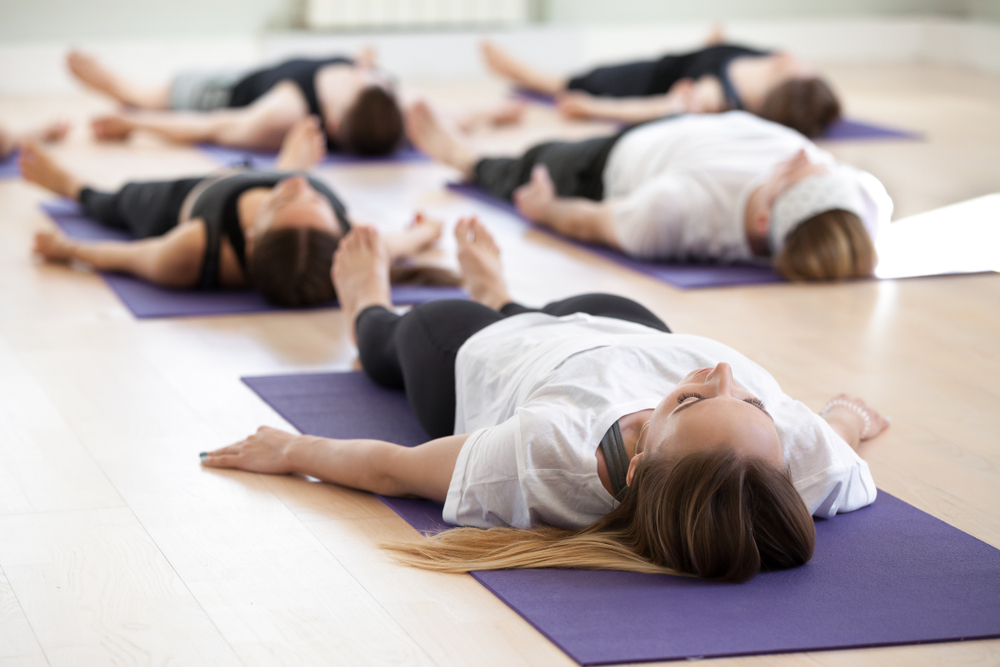
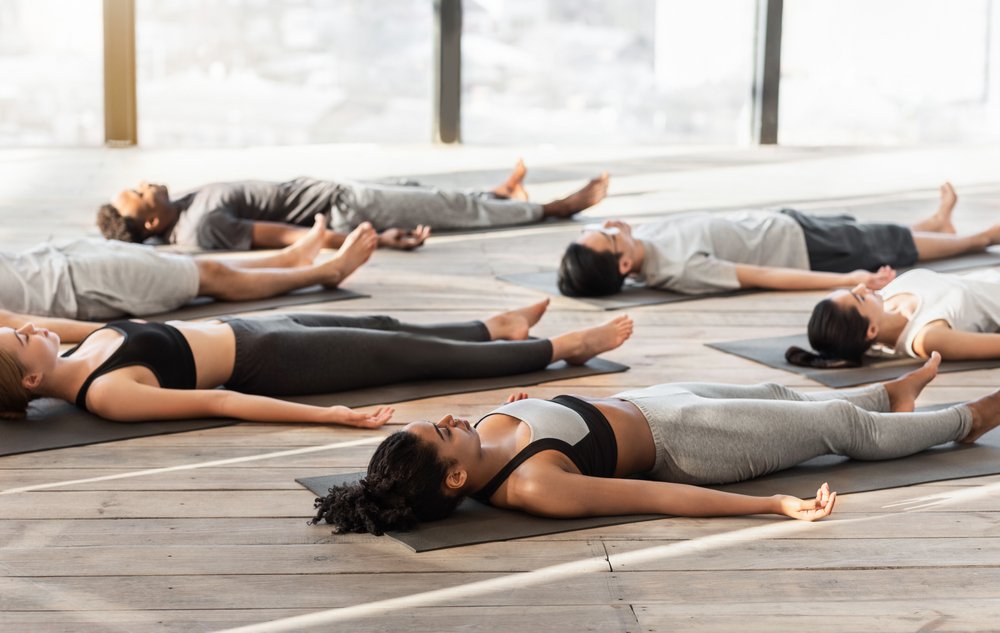
During a conventional yoga lesson, you are moving your body in all sorts of poses (asanas). You are totally still in Yoga Nidra. You rest in Savasana (Corpse Pose) and become as comfortable as possible by using blankets and pillows and just listen to the voice of a guide.
The magic occurs between the states of wake and sleep. It is a condition of postural rest that lets your body rest profoundly as you are consciously aware. Consider it a guided meditation but methodically relaxing every level of your existence—body, energy, mind, and feeling as well.
Science of Non-Sleep Deep Rest (NSDR).
NSDR (Non-Sleep Deep Rest) is a term that has been heard recently. It has been popularized by neuroscientists such as Dr. Andrew Huberman, and basically, it is a contemporary, secular explanation of yoga nidra.
Scientifically it is explained that Yoga Nidra takes your brain through various states of waves:
- Beta Waves: This is the state you are in at present—alert, thinking, and processing information.
- Alpha Waves: Once you start the practice and close your eyes, you shift into a creative, relaxing state.
- Theta Waves: This is the dream state. It is the place at which profound emotional healing and processes of memory occur.
- Delta Waves: This is the deep doze sleep without any dreams. It is here that the body does its heavy engineering, repairing and regenerating.
That is where we want to languish, between Theta and Delta, in Yoga Nidra. When you remain awake in such states, you are performing a factory restart on your nervous system.
The 5 Layers of You: Map of the Koshas.
Also Read: Finding Your Center: Understanding Samadhi Beyond the Asanas
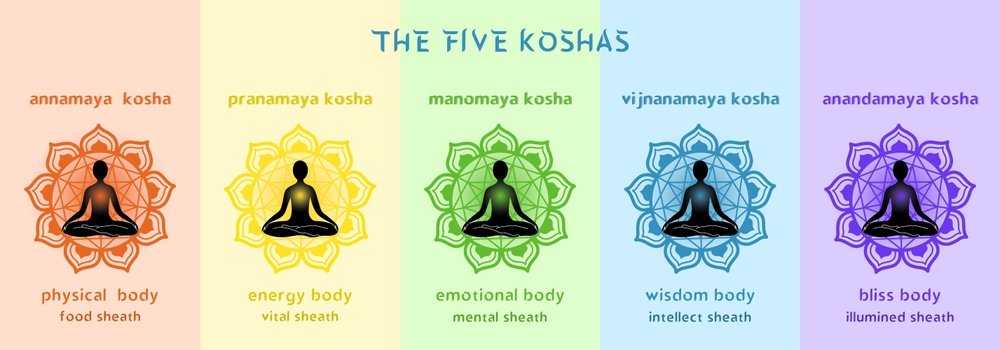
We are not a body, only in the yoga philosophy. We consist of five layers, or Koshas. Yoga Nidra is both special and universal since it caters to all five:
- Annamaya Kosha (Physical): This is where we begin by loosening the muscles and the physical frame.
- Pranamaya Kosha (Energy): This is breath awareness that we use to harmonize the energy (Prana) within the body.
- Manomaya Kosha (Mental/Emotional): We see thoughts and feelings and get carried away by them.
- Vijnanamaya Kosha (Wisdom/Intuition): This is when we are utilizing our inner knowing and subconscious mind.
- Anandamaya Kosha (Bliss): The fundamental part of our being, a state of absolute peace and happiness.
As you slowly shift through these layers, you are not merely out of your practice of taking a nap—you are giving your whole internal system a composition.
The Strength of the Sankalpa (Your Secret Weapon)
The Sankalpa is one of my favorite aspects of Yoga Nidra. A Sankalpa is brief, affirmative, or a resolve. It is the plant you sow in the fertile ground of your lazy mind.
A Sankalpa is rooted in deep truth, unlike a normal resolution of the New Year (a place where one is not good enough). It is never written in the past tense. You do not say, “I will be confident,” but I am confident and at peace.
When you repeat your Sankalpa in Yoga Nidra, then your mind is best prepared. You are rewriting your internal programming as you take a rest. It is incredibly powerful.
Yoga Nidra: A Step-by-Step Guide.
Also Read: The Science of Auras and How Yoga Affects Your Energetic Field
The best thing about the practice is that it can be done by any person. You do not need to be flexible, nor do you need to be good at meditating. Here is the way to position yourself to succeed:
1. Create Your Nest
Comfort is your top priority. You need to find a place that is not noisy. Rest your back on a yoga mat or even on a bed. Take a small pillow to place on your head and a bolster (or rolled-up blanket) under your knees to relieve your back. Drape a warm blanket over you because during intense relaxation, you will have a drop in temperature.
2. Set Your Intent
Shut your eyes and draw some deep breaths. It is at this time you remember your Sankalpa. Repeat three times emphatically upon the inside.
3. The Body Scan (Rotation of Consciousness).
The greatest number of guided sessions will take you on a journey of consciousness rotation. You will be requested to focus your awareness on certain areas of your body: the right thumb, index finger, wrist, elbow…
Pro-tip: Do not work so hard to focus. Just let the voice guide you. Should your thoughts stray, then you must kindly bring them back to what the instructions are saying.
4. Breath and Feeling
You will just shift into noticing your breath and not altering it. You may also be asked to fantasize about the opposite feelings, such as very heavy and then very light, or very cold and then very warm. This assists in balancing your brain.
5. Visualization and Return
Lastly, the guide may take you through some of the calming imagery. Then you need to end by resting in silence for a few minutes before gradually opening your eyes and repeating your Sankalpa one time again.
The reasons why you need to begin today: The advantages.
When you are still in doubt, here are some of the science-based reasons why Yoga Nidra should be given a go:
- Less Stress and Anxiety: It immediately reduces the levels of cortisol because it activates the parasympathetic nervous system (the rest and digest mode).
- Improved Sleep Quality: Daytime workouts might be part of how to control your sleep-wake.
- Chronic Pain Management: Deep relaxation helps in decreasing the pain signal sent to the brain.
- Increased Creativity: This will allow you to access the more creative, intuitive aspects of your mind because of the access to the theta state.
- Healing of the Heart: It offers the secure place to experience the emotions of being stuck and not lose control over them.
Common Questions We Get Asked
“What if I fall asleep?”
Honestly? It happens to the best of us! When you fall asleep, then evidently your body required the rest. The guidance is still heard by the subconscious mind, and hence you are still reaping the benefits. In due time you will be able to more readily remain in that state of borderland.
I cannot sit down and meditate. Is this for me?”
In fact, Yoga Nidra is the ideal practice for individuals with difficulties in sitting down and meditating. Since you are lying down and your mind is being employed (after the body scan), it is a lot more comfortable to have a focus as opposed to sitting in silence.
“How often should I do it?”
Every week is terrific; however, it can be life-altering to spend 15-20 minutes a day. Personally, we find the afternoon, during the mid-afternoon when there is a lack of energy around 3 PM, to be the best time to do it. It is superior to a third cup of coffee, believe me!
Final Thoughts
Yoga Nidra is not only some relaxation method; it is travel home to yourself. In a world where we are always asked to do more, be more, and have more, Yoga Nidra allows us just to be.
It serves as the reminder that you do not get to rest after having worked hard, but it is a basic necessity of a happy and healthy life. Therefore, whether you are watching Insta until your eyes are red, or you can experience a guided Yoga Nidra session this very evening. It will be good for your mind and body.
Namaste, and sweet dreams!