Fluid with Your Cycle: Yoga to Support Menstruation and Fertility.
Hello there, lovely soul.
We are very pleased to see you here. It does not matter whether this is your first time with the mat or you are an experienced yogini; We want you to breathe in. At this moment, this minute, it is impossible to know what your body is doing. It is ever changing, refreshing, and struggling toward equilibrium.
Being yoga instructors at Maa Shakti Yog Bali and having managed to survive through the ups and downs of hormonal wellness over the years, we have noticed that our bodies are not supposed to be in the same state. We do not move in straight lines; we move in circles. Nevertheless, we tend to dwell in a world that requires us to present ourselves in the same manner on a daily basis.
No matter how badly you have been going through painful periods, hormonal imbalance, or the emotional rollercoaster of a fertility journey, we want to tell you: you do not have to fight your body. Today, we will discuss ways in which yoga as a medicine for women’s health may be your best friend when it comes to discovering a rhythm, comfort, and strength.
Yoga and Hormonal Health: Reasons Why Yoga Matters.
Talking about yoga as a form of menstrual balance, we are not only referring to stretching. We can speak about the endocrine system. This is because your hormones are a sensitive orchestra; once the conductor (your brain) gets stressed, the violins (your ovaries) and the drums (your adrenals) begin to play in the wrong key.
Yoga helps by:
- Reducing Cortisol: Stress is the hormone hijacker. Increased cortisol has the ability to suppress ovulation and aggravate PMS.
- Enhancing Pelvic Circulation: Most of us spend the whole day sitting, and this stagnates blood flow to the reproductive organs.
- The Nervous System: It is necessary to regulate the nervous system to switch between the fight or flight and rest and digest modes of operation in order to help with fertility.
Phase 1: The Menstrual Phase in Winter.
Concentration: Free, Give up, Intense Intuition.
Your estrogen and progesterone are the lowest during your time. You may be exhausted, self-absorbed, or physically depressed. Neither is it the moment to run intensive HIIT exercises nor to engage in hot power yoga. This is your winter in the menstrual cycle syncing world.
The Practice: Relaxing Restorative Yoga.
At this stage, we would like to favor the downward energy movement (which is called Apana Vayu in yoga). Shun inversions (like headstands) that are in opposition to this natural flow.
Key Poses for Period Pain:
- Supta Baddha Konasana (Reclined Bound Angle Pose): Lie on your back with a bolster at the focus of your spine. Pray on the soles of your feet and fall down on your knees. This makes the pelvic bowl give room and eliminates the cramping.
- Child’s Pose (Balasana): Settle your forehead on the mat with knees sizable. This relaxes the nervous system and relieves a pained back.

Phase 2: Follicular and Ovulatory Phases (The Spring and Summer)
Vitality: Strength, Vitality, and Connection.
Your estrogen starts to increase as your period comes to an end. You will probably experience a boost of energy and social confidence. This is the most fertile time of yoga. We would like to strengthen your vital energy, ojas, and promote the healthy circulation of the blood to the ovaries.
The Practice: Heart-Opening and Hip-Opening Flows.
This is when it is time to be more active. Poses that open the hips and chest give a signal to the body that it is safe, open, and vibrant.
Among the important poses to help with fertility:
- Low Lunge (Anjaneyasana): This stretches the psoas muscle. Tight psoas may actually squeeze the area around the uterus. You are opening up the front of your hips, and you are welcoming life and breath to the reproductive center.
- Goddess Pose (Utkata Konasana): This is an effective female pose. It tightens the lower body and gives the pelvic floor a workout, which is great in hormonal regulation.
- Setu Pose (BRIDGE Pose): This is a gentle exercise that activates the thyroid gland, which is of huge significance in controlling your menstrual cycle.

Phase 3: The Luteal Phase (The Autumn)
Concentration, Stability, and Self-Care.
Progesterone increases after ovulation. This is usually the time when PMS symptoms such as bloating, anxiety, or irritability come into play. There is something happening to your body in the event of a pregnancy or a period. You may be more inward-turned.
The Practice: Hatha Yoga on the Ground.
This is the time to slow down. Practice standing, as it is something that makes you feel secure.
Key Poses for PMS Relief:
- Pigeon Pose (Eka Pada Rajakapotasana): We keep a lot of emotional strain on the hips. When you are irritable, a long, supported pigeon pose can be an enormous emotional release.
- Legs Up The Wall (Viparita Karani): This is the final reset button. It assists in bloating, swelling of the ankles, and informing your brain that it is time to relax.

The Mind-Body Relationship between Yoga and the Fertility Journey.
And when you are attempting to conceive, we can tell how heavy that wait can be. It is so simple to begin to consider your body as the project that should be controlled or, worse still, a machine that is broken.
Fertility yoga does not focus on correcting you. It has to do with making friends, with making a home, in a corporeal and mental sense. Most of the time, when you are practicing, you should attempt to change your way of thinking to receiving.
The Breath Strength (Pranayama).
Nadi Shodhana (Alternate Nostril Breathing) is one of the most vital items of fertility support. It is known to balance both the left and right sides of the brain and relax the endocrine system. Five minutes per day is enough to cut the stress indicators, which usually disrupt conception by a great margin.
Frequently Asked Questions: Woman Health Yoga.
Is yoga effective with PCOS or endometriosis?
Although yoga is not a cure, it is a strong managerial tool. In the case of PCOS, the active flows may aid in insulin sensitivity. In the case of endometriosis, restorative poses can be used to treat the chronic pain and inflammation of the pelvis due to the disease.
Is yoga safe during IVF?
Usually, yes, but you have to pay attention. At the stimulation stage of IVF, your ovaries swell up. Should not do deep twists or heavy poses on the abdomen. Pay attention to meditation and extremely supported movements. Never do the exercises without the recommendation of your doctor and qualified prenatal/fertility yoga instructor.
How often should I practice?
Stalemate defeats vehemence. It is reasonable that even 15 minutes of yoga a day is more beneficial for hormones compared to a single 90-minute session a week. Pay attention to your body—when you are feeling tired, do a 5-minute meditation. When you feel like it, take a full flow on an energetic day.
How to Build Your Home Sanctuary.
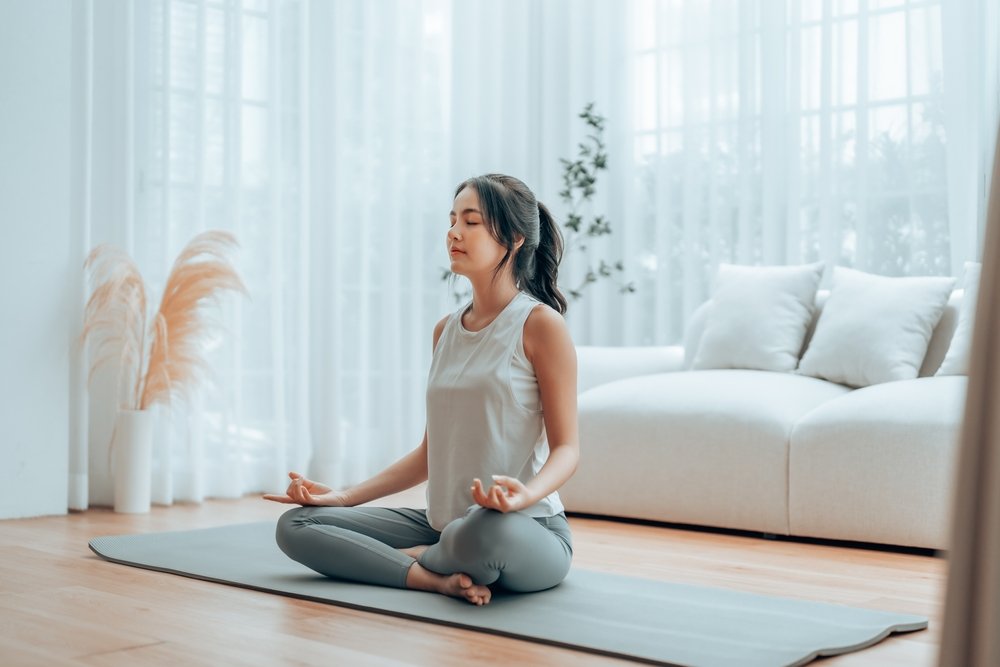
You do not have to visit a fancy studio to enjoy the benefits of yoga to reproductive health. One needs only a little space in her house and a few pieces of furniture (pillows and blankets would do just as well instead of bolsters!).
Guidelines to a healing home practice:
- Create a Purpose: The first step is to get an Intention: Before you begin, ask yourself, “What does my body need today?”
- Aromatherapy: Use lavender during the luteal phase; citrus may be uplifting during the follicular.
- Journal After: The largest discoveries are sometimes made immediately after Savasana. Write down how your body felt.
An Ultimatum of My Heart to Thine.
Your cycle is not a curse. It is a feedback loop. Your body gives the messages to you regarding what it requires. You are learning to speak that language by learning yoga as a method of the health of women.
You are allowed to slow down. You are permitted to occupy space. You can be just where you are in your cycle of life, and maybe it is time to bring your menstruality into harmony, or perhaps you just want to feel more at home in your own skin.
It is not the aim of yoga to reach your toes; remember, it is what you learn on the down ladder. Be patient with yourself. Your body is listening, and it is glad of the attention you are giving it.
Namaste.
Are you ready to begin your healing process?