Why Slow Movement Can Be More Powerful Than Intense Exercise
The world is one that is obsessed with speed. Whether it’s a higher PR on a HIIT session or a faster pace at a fast food joint, we are constantly being driven to go faster, go harder, and burn out sooner. In the mainstream fitness world, sweat is the currency, and the soreness is the badge of honor. But have you ever stopped on your yoga mat and thought, “What if it isn’t always about pushing ourselves to the max to build real strength?”
What if the thing we need to do differently isn’t necessarily faster, but slower?
From gentle Hatha yoga to restorative movement to a simple physical stretch, there’s a quiet revolution in fitness going on. So, why is slow movement more than a choice from a range of intense exercises? It could be the most effective tool we have for long-term health, strength, and inner peace.
The Illusions of “High-Intensity” Fitness
We’re not against high-intensity exercises, per se. They increase the heart rates, improve cardiovascular fitness, and provide a fast release of endorphins. But if high-intensity exercise is our only type of movement, a few limitations we are unaware of can come about:
- Chronic Overload: When our bodies are constantly on overdrive, it activates fight-or-flight and increases cortisol (the stress hormone).
- Greater Risk of Injury: Fast movements tend to be momentum-driven instead of muscle-engaged, thus putting stress on our joints, ligaments, and lower back.
Burnout is the point where exercise becomes an additional item on our to-do list, and we don’t have fun moving anymore.
Always seeking intensity can sometimes be ignoring what our bodies are trying to tell us. The power comes in instead, with mind-body connection and slow, deliberate movement.
The Secret Science of Slow Movement
Rather than rapid repetition, when we move slowly, mindfully, something amazing occurs within our nervous system and muscles. Here’s how slowing down can benefit our bodies and minds, inside and out:
1. Muscle Time Under Tension Builds True Physical Strength
In a squat or a yoga transition such as Chaturanga, there is a lot of momentum. However, if we take 5 full seconds to lower into a pose and 5 seconds to rise, we remove momentum.
This will put the muscles under more time under tension (TUT), which means the deep stabilizing muscles, core, and connective tissue will need to engage greater amounts of muscle fibers. Slow movement is not simple, as it is a challenge to muscular endurance and functional strength, which one cannot easily replace with fast exercise.
2. We Rewire Our Brains through Proprioception
Proprioception is our brain’s sense of our body’s position in space. The fast-paced approach to exercise may be on autopilot, while the slow approach requires full presence.
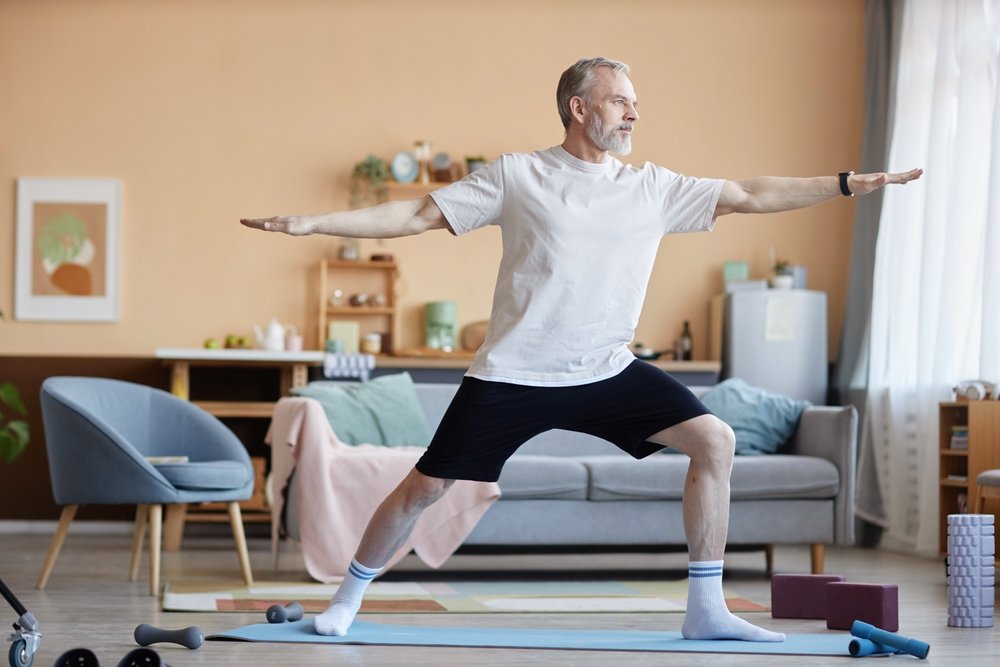
As we move slowly through a Warrior II pose or a mindful alignment, we create new neural pathways. This neuroplasticity enhances our balance, spatial awareness, and posture, which is an advantage that will carry us beyond our yoga mat.
To get things done quickly, use momentum to move and then tense the joints and shallow the breath.
Slow Movement —> Uses Muscle TUT —> Deep Stabilization —> Parasympathetic Activation
3. Relaxing the Nervous System to relieve stress
The vagus nerve is one of the most beneficial aspects of slow yoga and gentle movement. Slow, rhythmic breathing coupled to slow movement helps move the body away from the sympathetic stress and straight into the parasympathetic “rest and digest” state.
Slow movement helps to reduce the following:
- Better sleep quality
- Better digestion and metabolism.
- Reduced systemic inflammation
- Reduces anxiety and mental fatigue.
Slow movement vs. high-intensity workouts: a brief comparison.
Also Read: How to Prepare for Your First Yoga Teacher Training in Bali
To help us understand the difference between these two approaches, let us now examine them side-by-side:
| Physical & Mental Focus | High-Intensity Exercise (HIIT, Running) | Slow Movement Practice (Yoga, Somatics) |
| Primary Energy Source | Anaerobic / Fast-twitch muscle response | Aerobic / Slow-twitch muscle endurance |
| Nervous System Impact | Sympathetic activation (Fight or Flight) | Parasympathetic activation (Rest & Digest) |
| Joint & Ligament Strain | Moderate to High (Impact-driven) | Low to Restorative (Low-impact) |
| Primary Mental Benefit | Immediate endorphin spike | Sustainable stress reduction & mindfulness |
| Core Muscle Focus | Surface muscle groups | Deep stabilizing core & connective fascia |
To Make Slow Movement a Part of Our Daily Lives
Slowing down is a practice, and as with everything new, it requires a little patience. Not all running shoes are necessarily lost, and not all exercise is dynamic, but we can include some more mindful exercises into our week to introduce balance. This slower approach is also an important part of the learning experience in a 100 hour yoga teacher training in Bali, where developing awareness and understanding the body can be just as important as building physical strength.
Here are three easy ways we can begin to practice slow movement today:
1. Apply the “5-Second Rule” to Your Asana Practice.
Next time we pass through a yoga class, let’s slow down our transitions! Let’s take a full five-count inhale to get into Standing Forward Fold, rather than jumping from Standing Forward Fold to a Halfway Lift. Observe how the hamstrings take to the ball, how the core activates, and the amount of control we obtain.
2. Concentrate on Breath-Led Movement (Pranayama)
Let our breath come and go with our bodies, not forcing our breath to come and go with our bodies. If you inhale for 4 seconds, then hold the physical posture for 4 seconds. Like physical exercise for the breath, it calms the mind and makes meditation a moving exercise.
3. Practice Somatic Scans and Restorative Holds.
Spend 10-15 minutes at the end of the day practicing restorative yoga or a body scan. When we practice these poses, such as Child’s Pose (Balasana) and Legs-Up-the-Wall (Viparita Karani), for 3 to 5 minutes, we are able to let go of emotional tension that can have been held in our deep fascial networks.
Yoga is not about touching your toes; it’s about what you are learning on the way down. The traditional, mindful approach reflected in practices such as those at Maa Shakti Yog Bali allows movement to become an opportunity to listen to what the body and breath are teaching us. Slowing our movement by yoga allows us to listen to what the journey is teaching us.
Finding Our Balance
Strength does not necessarily equate to lifting the heaviest weight, running the fastest, or having sweaty clothes. Often, it is in the present moment, in the slow and difficult pose, when we hold space for our breath, when we honor what our body needs in the moment, that we find true strength.
It’s a gentle move that’s not a step backwards when we allow ourselves to slow down; it’s a strong step inwards.
We’ll all roll our mats up and take a deep breath and celebrate the power of our quiet, sustainable movements.